

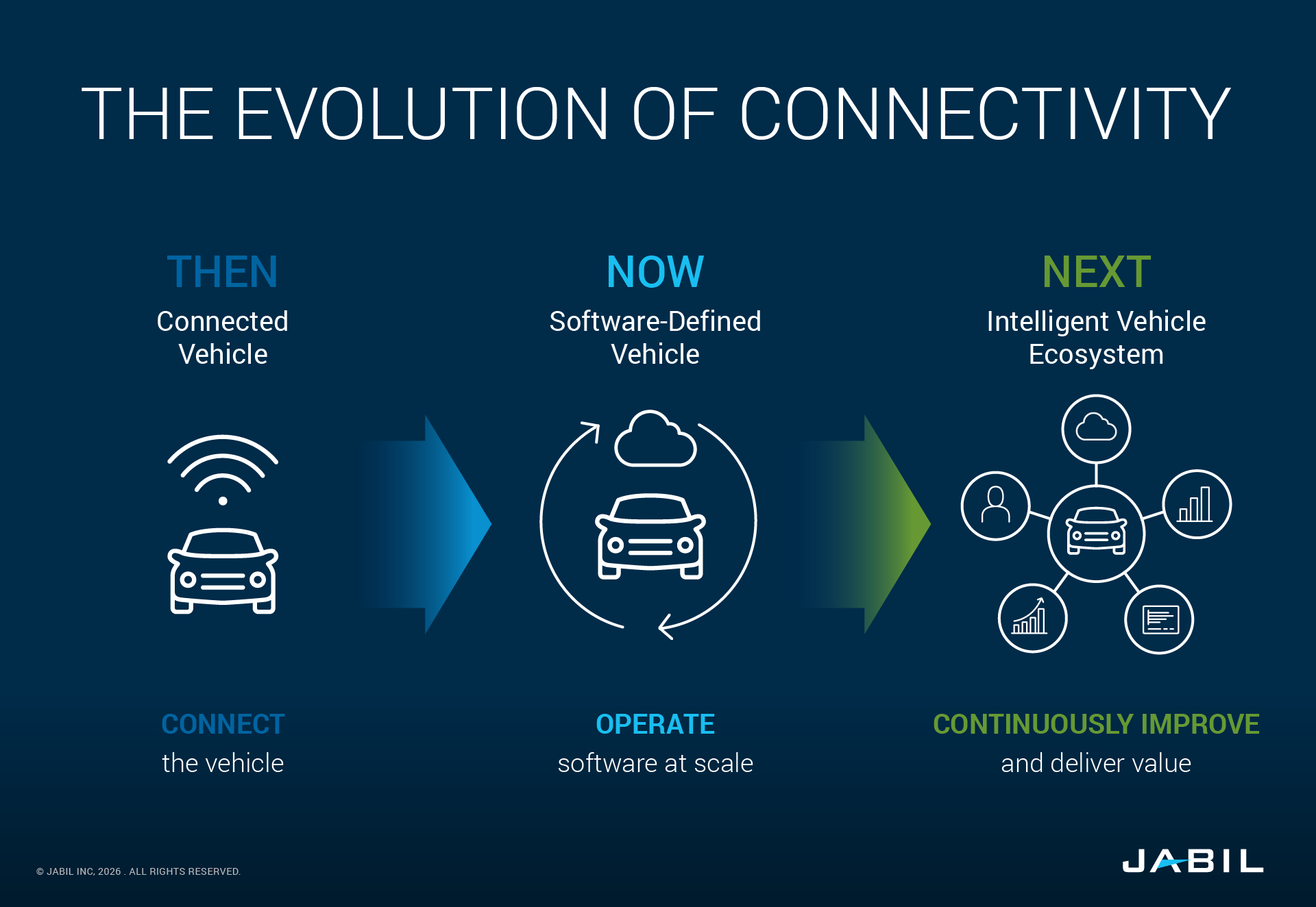
Connectivity now supports nearly every stage of the vehicle lifecycle, from manufacturing and operations to software deployment and digital services. As a result, automotive and transportation OEMs are increasingly treating connectivity as an integral part of how vehicles are designed, delivered, and supported over time.
By 2030, an estimated 90% of new cars will be connected. This represents a shift from connectivity as a vehicle feature to a scalable, enterprise-wide capability — one that manufacturers must design, deploy, and manage across vehicle platforms, regions, and operating environments.
Four strategic shifts are influencing this transition.
1. Operational Requirements Are Driving Connectivity Architecture
Effective connectivity strategies start with the vehicle’s mission, operating environment, application requirements, and expected lifecycle. These factors determine where continuous connectivity is essential, where intermittent connections are acceptable, and which network technologies provide the right balance of coverage, performance, and cost.
A passenger vehicle in a dense urban corridor has different connectivity requirements than a tractor in a remote field, a haul truck at a mine site, or a long-haul fleet traveling through rural regions. Software updates, telemetry uploads, and other non-time-critical cloud services can often store data temporarily and resume transmission when a connection returns. By contrast, time-sensitive and safety-critical vehicle functions must continue to operate reliably within their defined conditions.
This is one reason manufacturers are moving more processing into the vehicle. Often called edge AI, this approach allows AI-enabled analysis and decision-making to occur locally, rather than depending on a continuous connection to the cloud. As AI becomes increasingly embedded in the vehicle, the balance between edge and cloud computing becomes a fundamental architectural decision. Timely safety functions must operate locally, while connectivity enables the broader learning, analytics, and software ecosystem around the vehicle.
The goal is not simply to add more connectivity. It is adding the right kind of connectivity for the application, operating environment, and vehicle lifecycle.
These are the three network strategies addressing different connectivity requirements:
- 4G/LTE remains the backbone of many connected services, including telematics, diagnostics, fleet management, and over-the-air updates. These priorities are especially important for vehicle programs that operate across diverse regions where network availability and performance can vary significantly.
- 5G supports applications that require higher bandwidth, lower latency, or greater data throughput. As vehicle architectures become more software-defined, OEMs are evaluating how 5G can support advanced driver assistance systems, vehicle-to-everything (V2X) communications, richer in-vehicle experiences, and faster delivery of software and data services.
- Emerging non-terrestrial network (NTN) capabilities are expanding options for safety, emergency response, and supplemental coverage in remote operating environments. While terrestrial cellular networks remain the primary connectivity layer, hybrid strategies that combine cellular and satellite connectivity are becoming more relevant for resilience and coverage continuity.

As connectivity architectures become more flexible and capable, their role in the vehicle is expanding. Connectivity is no longer simply a communications layer linking vehicles to the cloud. It is becoming an important enabler of software delivery, connected vehicle intelligence, and continuous improvement throughout the lifecycle of a vehicle — changing how OEMs think about the vehicle long after it leaves the factory.
2. Connectivity Is Becoming a Core Enabler of Fleet Software Operations
Software-defined vehicles are changing the role of connectivity.
The flexible architecture of a software-defined vehicle allows manufacturers to accommodate vehicle and regional differences while maintaining common operating processes. This approach can reduce fragmentation and provide a more consistent foundation for software deployment across the fleet.
Updating one vehicle may be straightforward. Managing software across millions of vehicles, multiple model years, regional configurations, and changing network conditions is a fleet-scale operating challenge.
That consistency is especially important as internal combustion, hybrid, and electric vehicle programs coexist. New platforms do not immediately replace legacy architectures, compute, connectivity, or software, creating an increasingly complex mix of technologies to support. When each vehicle program relies on a tightly coupled connectivity architecture, this complexity and the associated operating costs grow with every new platform.
Manufacturers such as Mercedes-Benz, Volvo Cars, and General Motors are investing in unified software platforms that span multiple vehicle programs. The goal is not simply to add more software features, but to create a more consistent way to operate software across the fleet, reduce fragmentation, accelerate deployment, and continuously introduce new capabilities throughout the vehicle lifecycle.
3. ADAS and Vehicle Autonomy Are Changing How Connectivity Creates Value
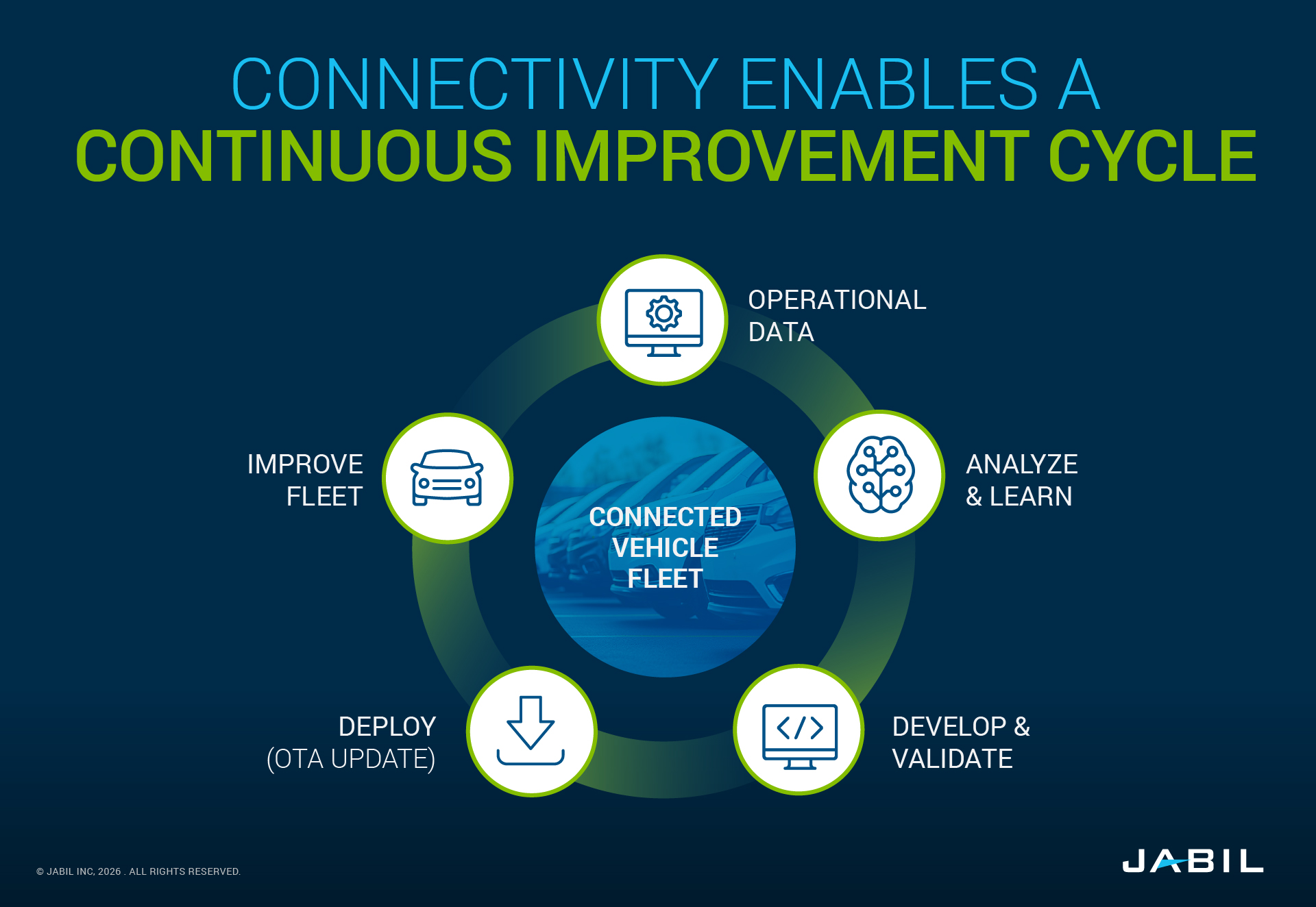
As ADAS and autonomous systems become more sophisticated, connectivity creates value in two distinct ways. It allows OEMs to collect selected information from vehicles in service, helping engineering teams understand how systems perform in real operating conditions. It also provides a channel for deploying validated software improvements across the fleet.
This applies across both consumer and commercial applications. In passenger vehicles, connectivity can support the ongoing improvement of ADAS and driver-supervised automation features. In commercial deployments, it can help operators understand vehicle and fleet performance within defined operating environments and optimize operations over time. While the use cases differ, both depend on the ability to capture, analyze, and act on information from vehicles in service.
Autonomous vehicles still cannot rely on connectivity for safe operation; critical driving functions must continue to operate when network connectivity is unavailable. Instead, connectivity supports the continuous improvement happening around those functions. For OEMs, this means connectivity architecture must support not only data and software delivery, but also the feedback loop that turns real-world vehicle experience into better-performing vehicles.
Recent industry developments show how this connectivity feedback loop works. When vehicles encounter unexpected real-world conditions, connected platforms can help manufacturers identify performance issues, validate improvements, and deploy updates across the fleet.
As ADAS and autonomous systems advance, connectivity is helping OEMs move from reactive issue resolution to continuous vehicle improvement. The ability to learn from real-world vehicle experience, deploy validated updates, and enhance performance across an entire fleet creates new opportunities to accelerate innovation and deliver value throughout the vehicle lifecycle.
4. Connected Vehicles Are Changing the Role of Governance
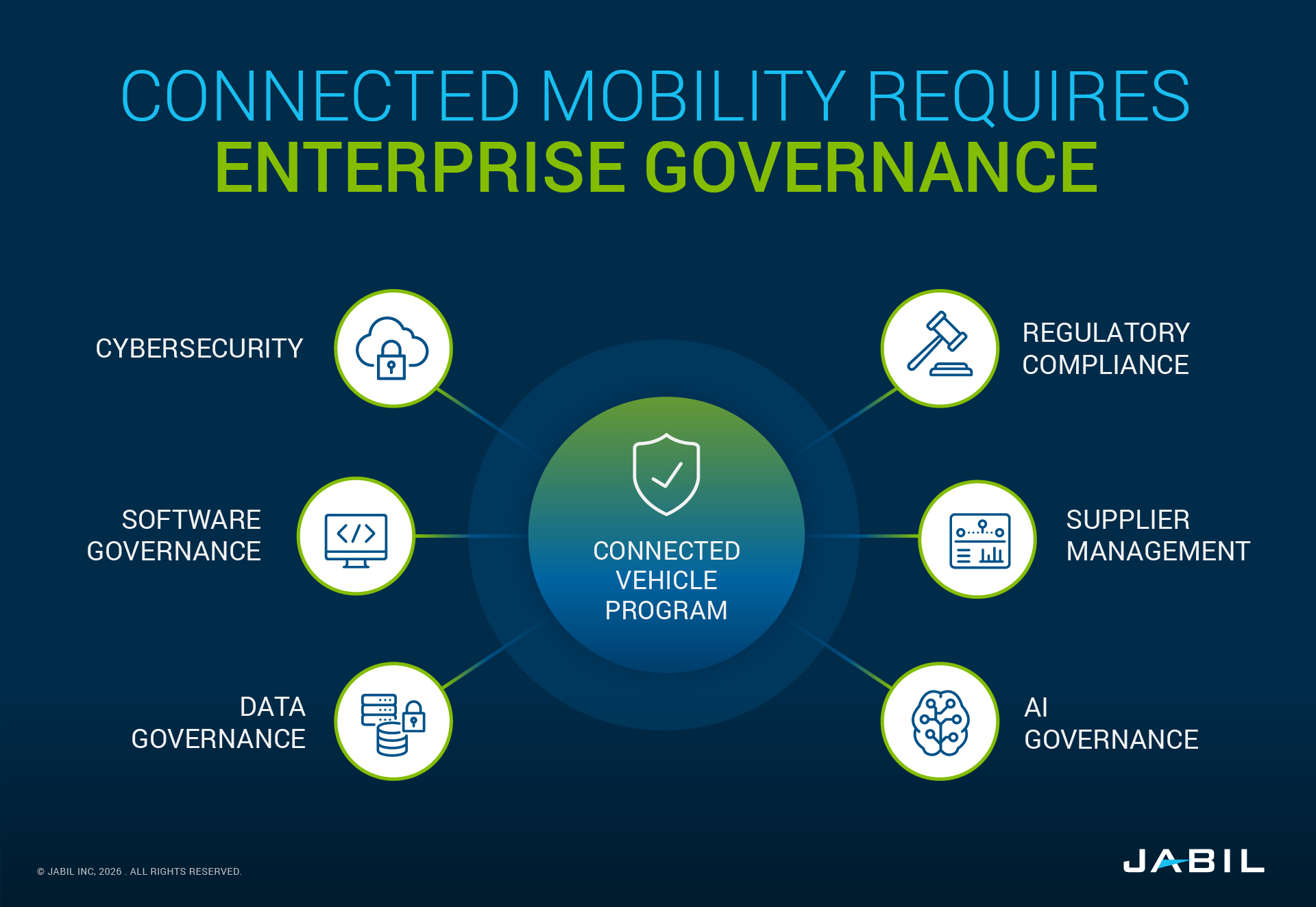
Connected and software-defined vehicles continue to change after they leave the factory. Manufacturers therefore need lifecycle governance: the roles, decision rights, policies and processes used to approve, secure, deploy, monitor and document changes across vehicles in service.
This governance covers software updates, cybersecurity, data use, AI-enabled capabilities, regulatory compliance, and supplier responsibilities. Its purpose is to ensure that changes are evaluated consistently and introduced safely across vehicles with different model years, platforms, regions and configurations.
The challenge of governing these changes grows as connected fleets become larger and more diverse. A single software change can affect thousands or millions of vehicles, making it increasingly complex to determine where, when, and how that change should be applied. Effective governance helps manufacturers determine which vehicles are eligible for a change, what validation is required, how deployment should be monitored, and how decisions should be documented.
The move toward lifecycle governance is also becoming visible in regulation. UNECE Regulations R155 and R156 require manufacturers to demonstrate ongoing cybersecurity and software update management, extending governance beyond vehicle development and launch. R156, for example, establishes requirements for software update management systems and the processes surrounding software updates throughout the vehicle lifecycle.
AI is making lifecycle governance more complex. AI-enabled vehicle functions, software development tools, and fleet analytics can change as new data becomes available and models are updated. That creates additional considerations for how those changes are evaluated, validated, and monitored after deployment. As AI becomes more embedded in vehicle systems, governance must account for how those capabilities evolve over time.
That is where governance becomes strategic. The goal is not simply to reduce risk or satisfy regulations. It is to create enough control to move quickly with confidence. When governance is embedded into software and connectivity operations, cybersecurity, compliance, and risk management can become part of the development and deployment process rather than a separate checkpoint that slows it down.
For OEMs, the shift is from governing a vehicle at launch to governing a continuously changing vehicle ecosystem. The organizations that can balance control with speed will be better positioned to introduce, manage, and improve connected capabilities throughout the vehicle lifecycle.
Looking Forward: The Next Chapter of Connected Mobility
Connected mobility is entering a new phase, one where the value of connectivity extends far beyond the connection itself. As vehicle platforms become more software-defined and connectivity architectures become more standardized, OEMs need partners that can manage increasing hardware, software, and supply chain complexity while supporting global platforms across multiple regions and vehicle lifecycles.
The opportunity is to turn connectivity into a scalable business capability, one that enables continuous improvement, accelerates innovation, and helps manufacturers deliver more value throughout the life of the vehicle. For OEMs, the question is no longer whether the vehicle will be connected. The competitive question is how effectively OEMs can use that connectivity to learn, improve, and create value throughout the vehicle’s life.
How can Jabil support your connected vehicle project? Contact us.
No matter how complex or demanding the project, we’re leveraging our expertise in bringing automotive connectivity to market. Get started with a trusted partner.